The short version
There is no single best flat roof membrane for Edmonton. There is a best membrane for a given building. SBS, TPO and EPDM all perform well here when they are designed and installed properly, and all three fail early when drainage is poor or the details are rushed.
As a rule of thumb: 2-ply SBS is the regional workhorse and the safe default for most commercial and industrial roofs. TPO earns its place on large, simple roofs where a white surface and welded seams help. EPDM suits big, open roofs with few penetrations and no grease or oil exposure. The rest of this article explains why.
What each membrane is
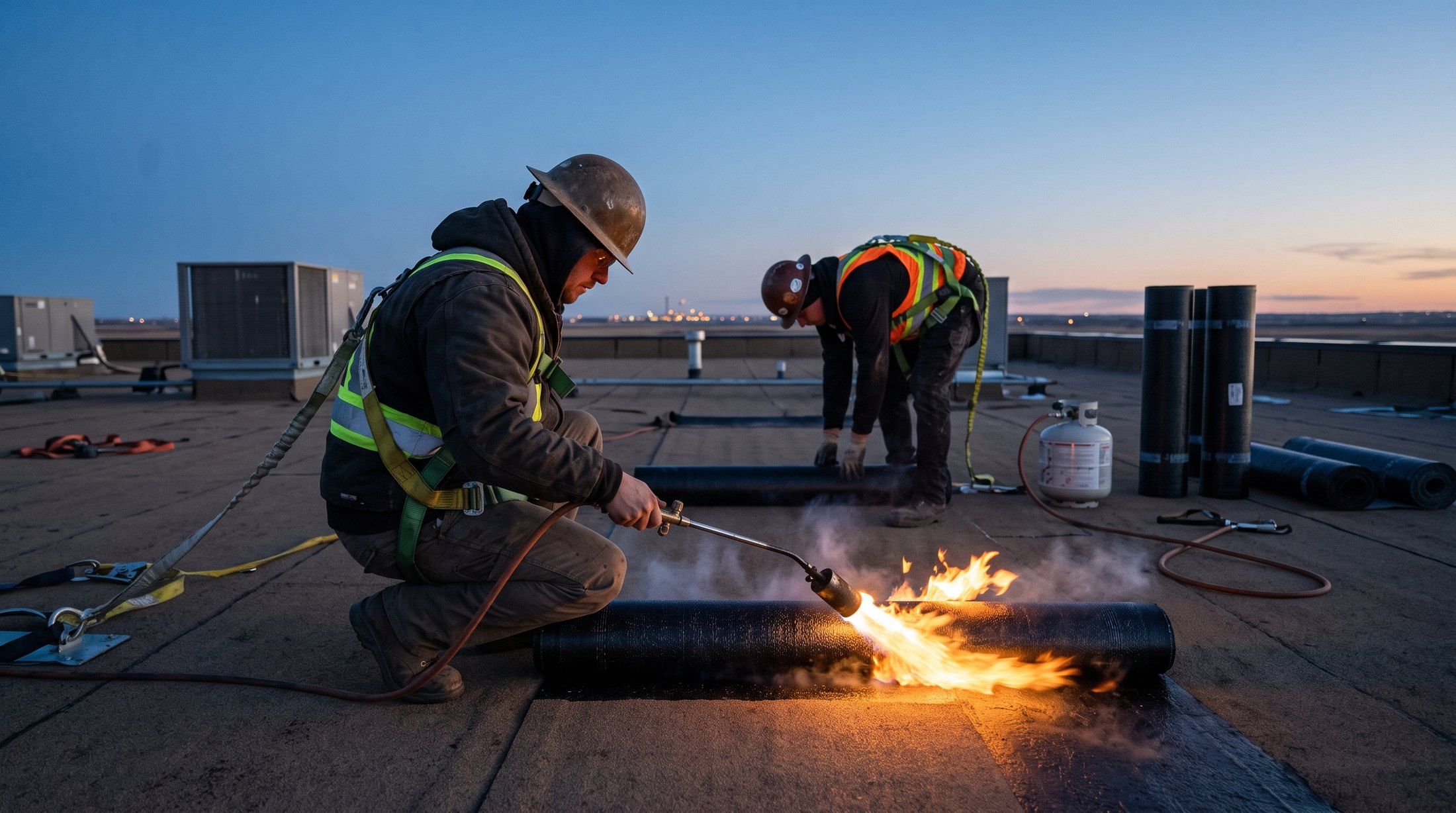
SBS modified bitumen is asphalt blended with styrene-butadiene-styrene rubber and reinforced with a polyester or glass mat. On commercial roofs it goes down in two plies: a base sheet and a granulated cap sheet. The plies can be torch-applied, set in hot asphalt, cold-adhered or self-adhered.
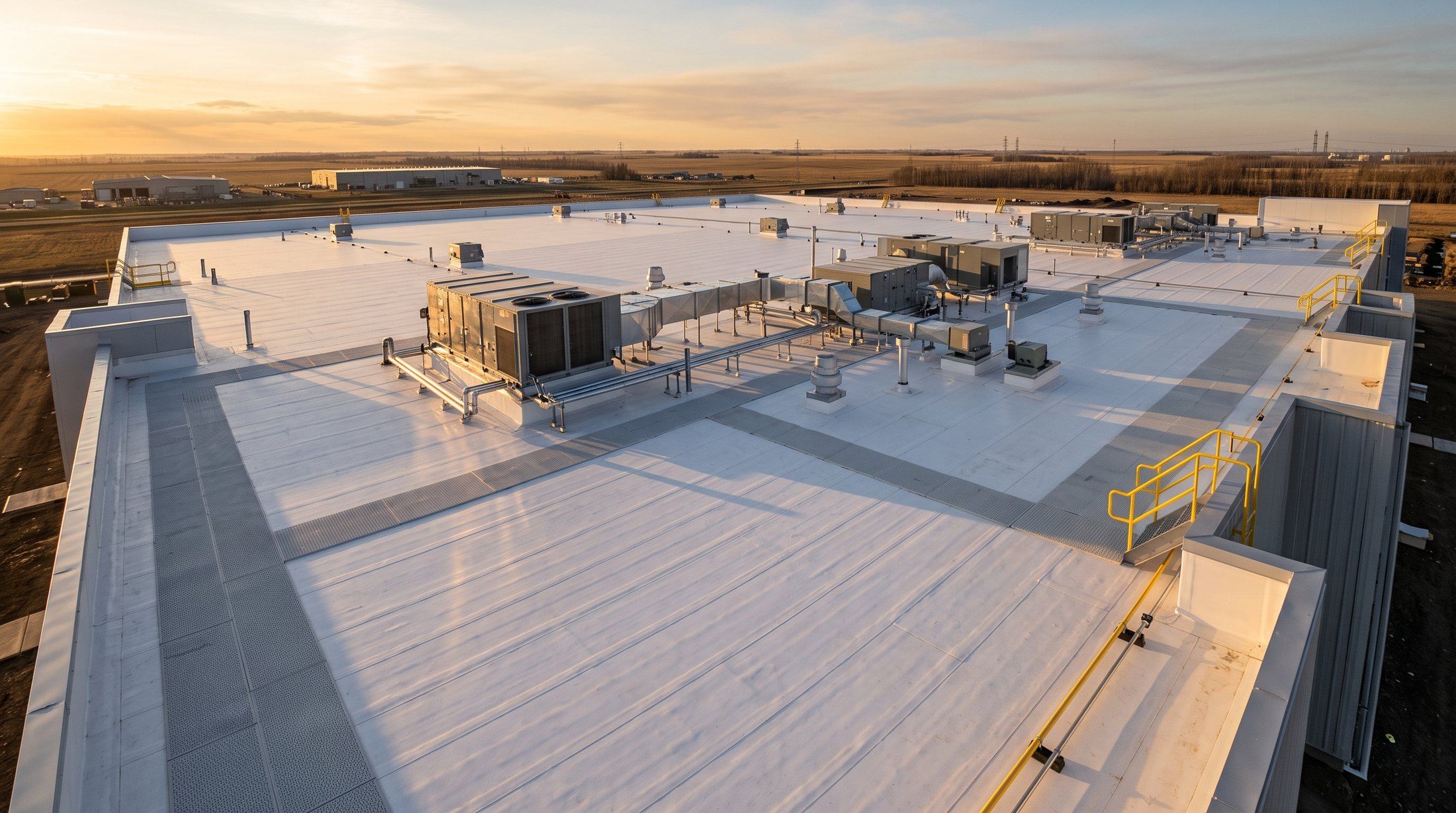
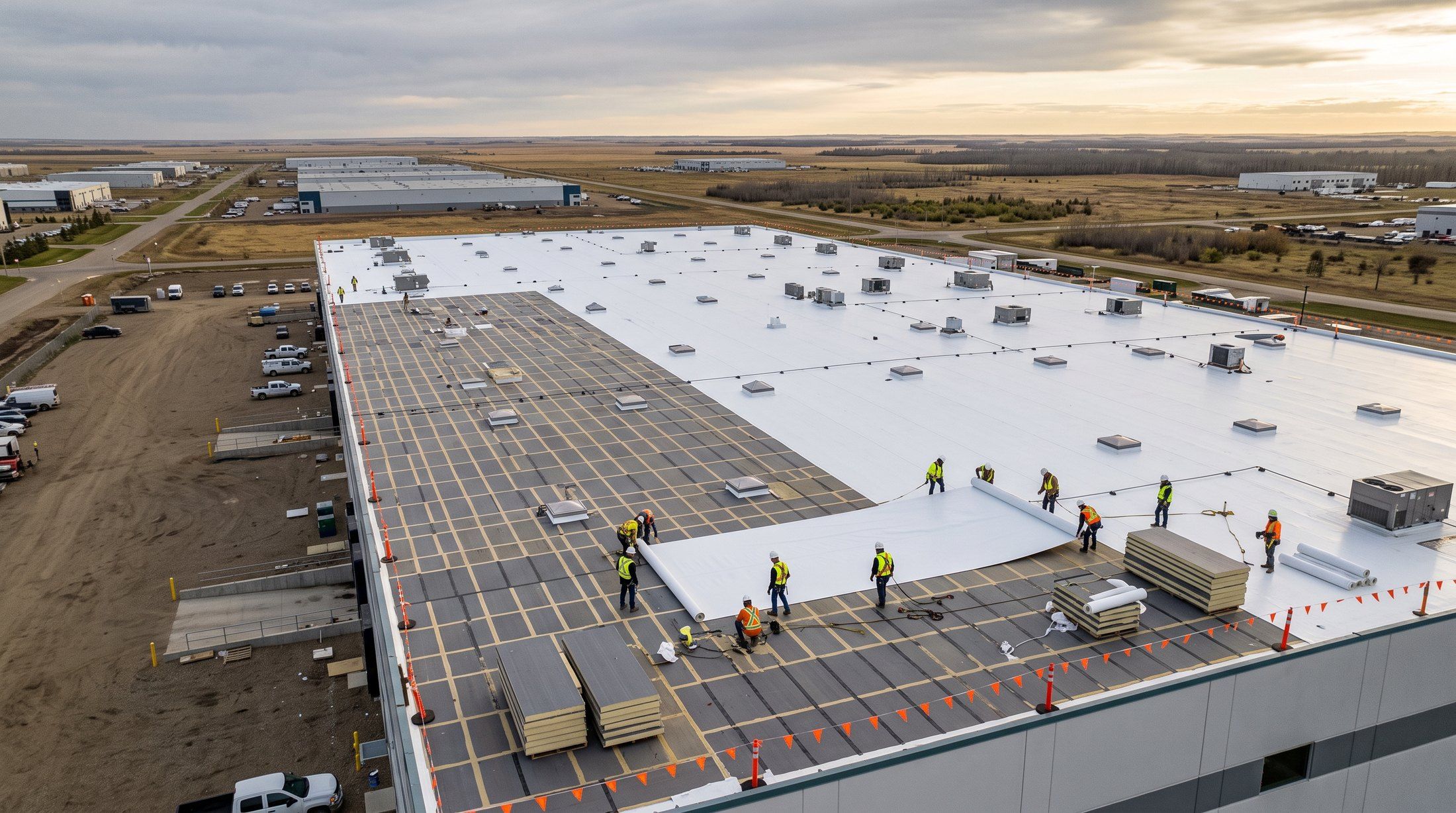
TPO (thermoplastic polyolefin) is a single-ply sheet, usually white, commonly 45, 60 or 80 mil thick. Its seams are welded with hot air, so the overlaps fuse into one piece. It is mechanically fastened or fully adhered.
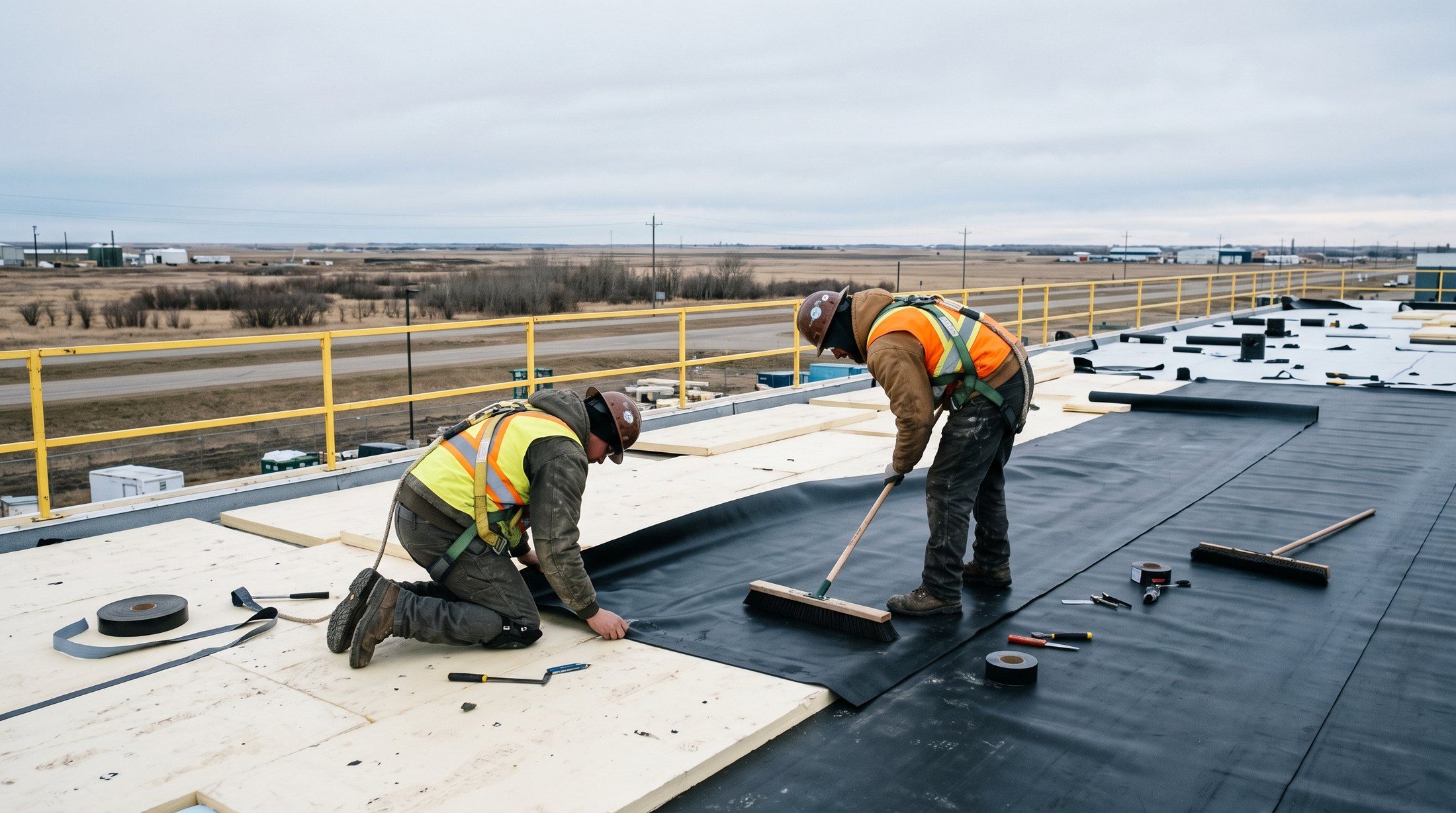
EPDM is a synthetic rubber sheet, usually black, commonly 45, 60 or 90 mil. It comes in very large sheets, so a roof has fewer seams, and those seams are joined with primer and seam tape. It is fully adhered, mechanically fastened or ballasted with stone.
Cold, snow and freeze-thaw
Edmonton roofs spend months under snow and go through freeze-thaw cycles every spring and fall. The membrane has to stay flexible in deep cold and keep its seams tight while ice forms and melts around them.
SBS rubber keeps the bitumen flexible at temperatures that would crack plain asphalt, and two plies mean a defect in one layer is backed by another. EPDM is rubber all the way through and stays flexible in severe cold, which is one reason it has a long track record on northern roofs. TPO becomes stiffer in the cold. That matters less for the finished roof than for installation, where cold sheets are harder to handle and welding settings have to be adjusted through the day.
Snow load itself is a structural question more than a membrane one. What a membrane does need is drainage that works when the snow melts, because meltwater with nowhere to go is the start of most spring leaks.
Hail and punctures
Summer hail is a real risk around Edmonton. The August 2019 storm caused about $90 million in insured damage across west Edmonton, Spruce Grove and Stony Plain.
2-ply SBS with a granulated cap has the most mass of the three and handles hail and dropped tools well. EPDM's rubber gives under impact and holds up better than its thickness suggests, especially at 60 or 90 mil. TPO is more likely to bruise or split, particularly as it ages.
With any single-ply membrane, the weak point in a hailstorm is often the insulation underneath. Soft insulation crushes, and the membrane is damaged over the dent. A high-density cover board under the membrane is the most cost-effective hail protection on a TPO or EPDM roof.
Seams: where flat roofs actually leak
The field of a flat roof rarely leaks. Seams, flashings and drains do. Each membrane joins differently, and each has its own failure mode.
- SBS: overlaps are fused with heat or adhesive, and the two plies are staggered so seams never line up. Poor torching at laps is the usual problem.
- TPO: welded seams are very strong when done right, and every seam can be probed to check it. Dirty or cold-welded seams are the usual problem.
- EPDM: taped seams depend on clean, primed surfaces and good pressure. Seams that were not primed properly can open years later.
Reflectivity and energy in a heating climate
White TPO reflects sunlight and keeps the roof surface cooler in summer. In hot climates that is a major energy saving. In Edmonton, where heating dominates the year, the benefit is smaller. It still helps buildings with real summer cooling loads, such as warehouses with temperature-sensitive stock, offices, labs and data rooms. For a cold storage shed or an unconditioned shop, colour matters much less than insulation and air sealing.
Grease, chemicals and rooftop traffic
Exhaust from kitchens, process equipment and some industrial operations lands on the roof. EPDM is damaged by oils and animal fats, so it is a poor choice near grease exhaust. SBS is also softened by some oils and solvents. TPO handles some exposures better, and PVC, a related single-ply, is often the better choice for restaurant exhaust and chemical exposure.
For roofs with heavy maintenance traffic, the granulated cap on SBS is the most forgiving. On single-ply roofs, walkway pads to every rooftop unit are worth the small cost.
Installation season and method
The roofing season here is short, and many projects run into October or start in April. Many adhesives have minimum application temperatures, which limits fully adhered TPO and EPDM work in the cold. Mechanically fastened systems are less restricted.
SBS torch-on can be installed in cool weather but it is hot work, with an open flame on the building. Occupied buildings, wood decks and combustible details call for fire watches, permits and cold-applied or self-adhered products at the risky spots.
Lifespan and warranty
A well-installed, maintained roof of any of the three commonly lasts 20 to 30 years. Manufacturer warranties vary by system: SBS is often 10 to 20 years, while TPO and EPDM can reach 25 to 30-year no dollar limit (NDL) warranties on qualifying systems with approved installers. The warranty length depends more on the specified system and the installer's status with the manufacturer than on the membrane type alone.
A practical way to choose
Work through these questions with your roofer before you settle on a membrane:
- Is the existing deck and insulation dry, or does the roof need a full tear-off?
- How many penetrations, curbs and rooftop units are there?
- Is there grease, oil or chemical exhaust on the roof?
- How much foot traffic does the roof see?
- Does the building have a summer cooling load worth reducing?
- Can torch work happen safely on this building, or should the system be cold-applied?
- What warranty does the owner, lender or specification require?
Getting a recommendation for your building
The right membrane comes out of the roof itself: the deck, the insulation, the drainage and how the building is used. If you are planning a re-roof in the next year or two, we can assess the roof and give you a written recommendation at no cost, with the reasons spelled out.